Haruki Murakami’s Got His Hooves in Me Again!
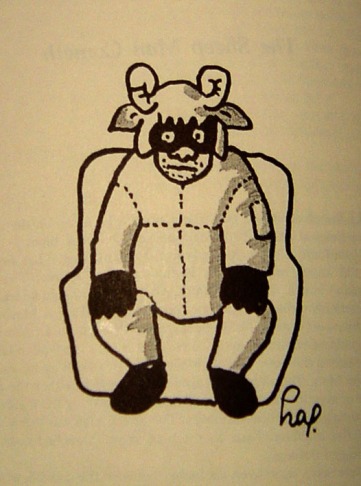
I’ve been on a Japanese kick again, reading-wise, triggered by a new Haruki Murakami novel The City and Its Uncertain Walls. And after finishing that typically enigmatic book, I realized that there is a considerable backlog of Murakami (he’s written some sixty books) as yet unread by me. So in I dive!
Serendipitously, the next title in my random search through his back catalog landed me on Hard-Boiled Wonderland and The End of the World, published some 43 years previously. I say serendipitous because a lot of the same settings, and some of the same characters, can be found in both books, even though they are stand-alone works that don’t relate to one another in terms of chronology or character development. Just another foray into the Murakamiverse.
I keep returning to Murakami, and his contemporary Kazuo Ishiguro, because I consider them both to be masters of their crafts who are similar but not the same. Both authors write primarily in first-person singular, usually with a male protagonist. And appropriately enough, both have that quality of ‘Japanese reserve’ where nobody tends to raise their voices or butt heads with others. The direct opposite of someone like Thomas Pynchon, say, where you always feel like you are attending a frat party of oversexed grad students heading into another bull session/bender filled with drunken excesses and conspiracy revelations.
My latest Murakami is the first novel he sat down to write as a full-time professional novelist, around 1980. The unfortunate title is A Wild Sheep Chase, a sort of clumsy translator’s gimmick designed to get Western readers to pick up the book, although the Japanese title is closer to An Adventure Concerning Sheep–which sounds like a Monty Python sketch, so I guess you can pick your poison.
It reads like a detective novel to a degree, wherein a young man at loose ends is pressed into an ill-defined mission that he must accomplish or perish. Essentially, he is tasked with finding a specific sheep possessing magical properties, who is capable of inhabiting a succession of human hosts and then bending that host to whatever task cannot be readily carried out by a sheep, while cloaking its agenda in mystery. We never really find out the sheep’s true motivation, merely that it’s capable of much more than we can comprehend.
One reason I love reading Murakami is that the plot is seldom the main point of his books. The ‘mystery’ has more to do with the inner workings of the never-named protagonist as he negotiates his way through all the quirky characters that propel him toward or hinder him from his goal, nebulous as it is. We learn very little about him in terms of backstory. In this way, every page is fresh because we’re never really quite sure how he will react to his journey, which is by turns fantastical and mundane. Hell, he doesn’t even have a name!
That being said, he takes most things calmly in stride, even when the going gets hallucinatory. And it’s not random at all–everything builds on what came before, so there’s no sense at any time that Murakami is just throwing things at the wall to see what will stick. In fact, the last act of Sheep reminds me a lot of Stephen King’s The Shining, published some three years earlier, albeit with a more claustrophobic cast and minus most (but not all!) of the horror elements. It certainly has some things to say about isolation.
But whereas KIng always hurries us forward in a relentless page-turner, Murakami does practically the opposite–forcing us to slow down and consider what just happened and how it relates to the stuttering narrative. We’re forever being propelled forward, then pulled back. That sounds frustrating, and maybe to those weaned on Agatha Christie it is, but I find it fascinating. Then again, I prefer books and movies that lack a clearly defined wrap-up, so there you go. I’ve yet to read any book by Murakami that ties up all the plot points neatly with a bow, and his work is the better for it.
When I finished A Wild Sheep Chase, I sat for a bit and considered it. I guess the best analogy, for me, is that reading Murakami is like studying a chunk of variegated quartz from a variety of angles. Following the linear events may not be the best path to understanding, but if you step back and view all the starts, stops, and striations in as nonlinear a way as possible, you are still amazed within a maze–but it’s not necessarily an unpleasant place to be.
Anyway, I’m an introvert at heart, so I don’t mind wandering around in the Murakami Thicket. This may or may not be your thing. Ewe know who ewe are.
- Posted in: Dimestore Philosphy ♦ Scattergories ♦ Uncategorized
- Tagged: book-review, book-reviews, books, fiction, haruki murakami, kazuo ishiguro, novels, sheep, stephen king, thomas pynchon
 saxsalon